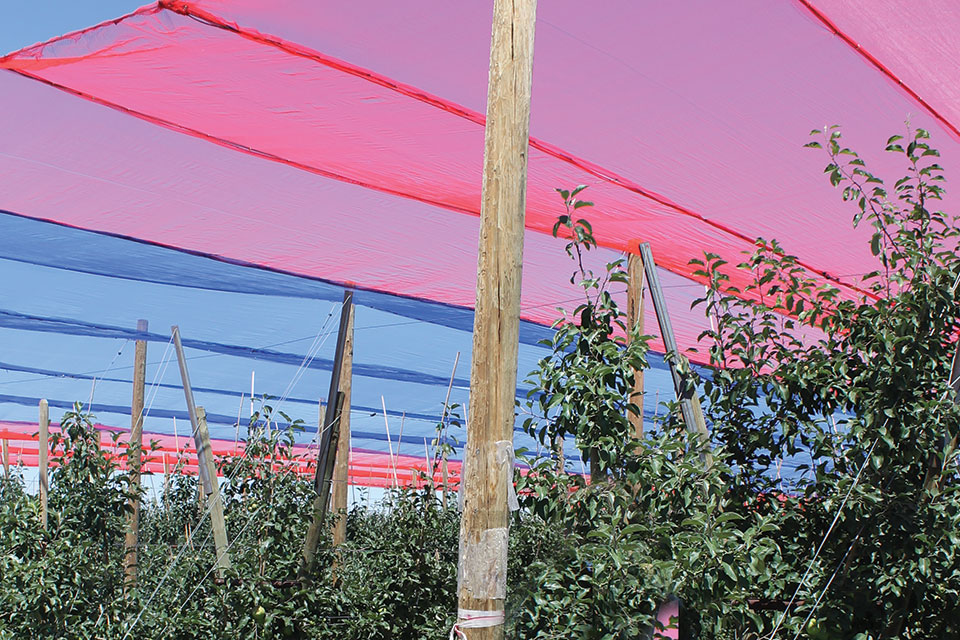
In
field trials, red photoselective netting reduced light intensity and
photosynthetic active radiation by 25%. (Photo: David Eddy)
According to the
Washington State Tree Fruit Research Commission (WTFRC),
“Sunburn remains the leading cause of apple cullage and reduced
packouts in Washington, in some years accounting for more than half of
all off-grade fruit.”
To address the issue of sunburned fruit, as well as look at other
potentialities, the WTFRC and Washington State Department of
Agriculture Specialty Crop Block Grant program funded a study by a team
of Washington State University (WSU) experts in tree fruit physiology,
beginning in 2015. The study aimed at determining how photoselective
hail netting might impact tree fruit quality and quantity, as well as
overall orchard health in a climate zone where high summer temperatures
and considerable sunlight are routinely present.
Two-Year Study
The study, with tree physiologist Lee Kalcsits acting as lead
investigator, led to a number of significant findings, some of which the
team found to be a bit surprising and some that need further
examination, monitoring, and assessment. Other researchers who were part
of the team included Drs. Desmond Layne, Stefano Musacchi, Giverson
Mupambi, and Sara Serra, as well as Tory Schmidt from WTFRC.
Over a two-year period, Kalcsits and his team tested the effect
of pearl, blue, and red netting on the orchard environment. They studied
physiology and fruit quality of ‘Honeycrisp’ apples grown in two areas
of Eastern Washington State, comparing the results to those measured on
an uncovered control plot.
“Environmental sensors recorded air temperature, relative
humidity, wind speed, light intensity, soil temperature, and soil
moisture in each treatment through the 2015 and 2016 seasons. In both
years, fruit sunburn data and fruit quality were recorded at harvest and
after four months of regular atmosphere storage,” according to the
report on the study’s results released in 2017. “Vegetative growth,
flower induction, and fruit set were also measured. Plant water status,
photosynthesis, and light-use efficiency were recorded throughout the
growing season in 2016.”
Importance to Growers
Significant findings from the study included:
- Photoselective netting reduced light intensity differently,
depending on color. All 20% netting reduced photosynthetic active
radiation (PAR) by between 25% (red) and 21% (pearl). When using a new
netting product, it is recommended that light intensity is verified
using sample material before purchasing.
- Netting strongly reduced wind (by more than 50%) but did not affect air temperature in the tree canopy.
- Netting altered the spectra of incoming light and created a better
light environment for plant and fruit growth. This was particularly true
for the pearl netting that provided more scattered light than the other
colors.
- Absorptive surfaces (fruit, leaves, soil) were more affected by
netting than the air under the canopy. Soil, leaf, and fruit
temperatures were all lower by using
20% netting.
- Netting reduced light and heat stress on the tree and improved leaf-level photosynthesis and light-use efficiency.
- Netting increased flower induction and fruit set after a heavy crop year in pearl and red netting.
- Canopy growth was greater under netting than for the uncovered control.
- Netting increased fruit size and had no major negative effects on
fruit quality. There were small reductions in color development with the
blue and red netting in 2015.
- Netting strongly reduced sunburn compared to an uncovered control
and provided a similar level of sunburn control to evaporative cooling
in 2016.
Significant Water Savings
An aspect of the WSU investigation that has, perhaps, been less
appreciated than it ought to be regarding the future of fruit growing in
arid and semiarid regions is water use.
An increasingly scarce and expensive commodity, water is a concern for
fruit and vegetable growers in most regions of the U.S. The ability of
netting to act as a substitute for evaporative cooling, Kalcsits says,
combined with other advantages netting provides may, in the future, make
netting a good choice even for growers of lower-value cultivars.
Quantifying the water use differential between evaporative cooling and the use of netting is ongoing, according to Kalcsits.
“Currently, we are working to quantify the amount of water saved
through both the reductions in water use through not having to use
evaporative cooling, as well as water savings through reduced
evapotranspiration from the orchard. These effects may benefit the
growers, particularly in regions that may face water restrictions in
years when the snowpack is low, like it was in 2015 in Eastern
Washington.”
Pros and Cons
Any technology has advantages and disadvantages. Retrofitting an orchard
can be expensive, and nets need to be installed and taken down each
year. Kalcsits points out cultivar value, ongoing hail risk, and “the
logistics and engineering of retrofitting,” are all issues to consider
in making the decision to use netting. Net selection is also important,
he says.
“Lower-shade percentage materials should be used in cooler or
cloudier climates; higher-shade materials can be used in high light
environments like Eastern Washington,” he says.
How important will photoselective netting be in the future?
Kalcsits and his colleagues reported on their finding regarding the WSU
examination in the journal,
Agricultural and Forest Meteorology:
“In regions with high light intensity and air temperatures, there
is a fine balance between optimizing growth and quality, and
overexposing the apple tree or fruit to excess abiotic stress. In the
future, as temperatures increase and fruit mature earlier, the risks of
heat and light-related stress such as sunburn will increase. We
anticipate that protected fruit cultivation under nets will play a
substantial role in crop protection,” the research findings say.
“Through the reductions in light intensity and wind speed, protective
netting has the potential to reduce the amount of stress to which an
orchard is exposed and mitigate the impacts of warmer temperatures and
better control fruit maturation in these conditions. Furthermore,
netting can reduce wind damage to the fruit.”
Petree is a public policy consultant and freelance writer based in Bellingham, WA.
See all author stories here.